

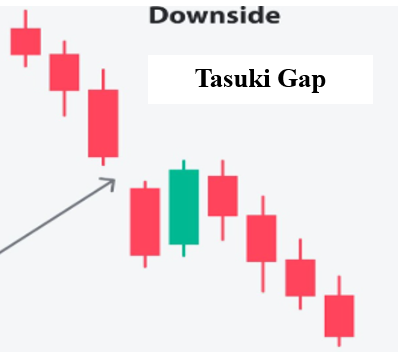
The Downside Tasuki Gap candlestick formation is a three‑candle continuation pattern that reinforces bearish sentiment. It highlights how sellers maintain control even when buyers attempt a brief recovery, making it a deceptive but reliable signal of ongoing weakness.
Candle Sequence in Detail
- First Candle – Bearish Continuation: A strong bearish candle appears, extending the prevailing downtrend.
- Second Candle – Gap Down Confirmation: Another bearish candle opens with a downward gap and closes lower, strengthening the bearish outlook.
- Third Candle – Trapped Bullish Attempt: A bullish candle forms within the body of the second candle and rises into the gap but fails to close it, showing lack of buyer strength.
Distinctive Attributes
- Typically emerges during a downtrend, reinforcing continuation rather than reversal.
- The second candle’s gap down is the defining feature, signaling strong seller dominance.
- The third candle, though bullish, remains confined within the gap, highlighting weakness.
- The signal gains credibility when supported by high trading volume on the bearish candles.
Sentiment Dynamics
- Seller Control: The first two candles reflect strong pessimism, with sellers pushing prices lower.
- Buyer Hesitation: The third candle shows an attempt to reverse momentum, but the move lacks conviction.
- Renewed Aggression: Sellers interpret the failed bullish attempt as weakness, reinforcing the continuation of the downtrend.
This psychological sequence demonstrates how the Downside Tasuki Gap captures failed optimism, turning it into confirmation of bearish strength.
Analytical Considerations
- The Downside Tasuki Gap is rare, requiring precise gap and alignment.
- Without confirmation, it may represent only short‑term consolidation rather than a true continuation.
- Best interpreted when paired with momentum indicators (RSI, MACD), moving averages, or volume analysis to validate the setup.
Contextual Importance
- During Strong Downtrends: Acts as reinforcement of bearish conviction, suggesting further declines.
- Near Support Levels: Serves as a sign that temporary bullish moves are failing to disrupt the broader trend.
- Volume Confirmation: Heavy trading activity during the bearish candles adds credibility to the continuation signal.
Final Insight
The Downside Tasuki Gap candlestick pattern is a deceptive setup: although the third candle is bullish, its inability to close the gap makes it a bearish continuation signal. Its rarity and precision make it noteworthy, and when confirmed by volume or supporting indicators, it provides traders with confidence to stay aligned with bearish momentum. Recognizing this formation helps market participants avoid false optimism and anticipate sustained downward movement.
