

The Short Line candlestick formation is a single‑candle pattern that reflects weak momentum and limited price activity. Its small body and short shadows highlight indecision, where neither buyers nor sellers show strong conviction.
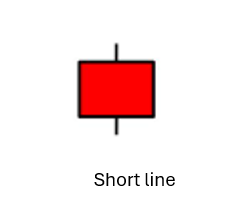
Candle Anatomy
- Body: Very small, showing minimal difference between the open and close.
- Shadows: Short or nearly absent, indicating restricted price fluctuation.
- Appearance: Compact and unimposing, often blending into the chart compared to more dramatic patterns.
Distinctive Attributes
- Can appear in both uptrends and downtrends, making it context‑dependent.
- Represents hesitation or weak trading activity, as the market fails to extend in either direction.
- Gains significance when it forms after extended moves, hinting at potential pause or reversal.
- Often considered a neutral signal unless confirmed by subsequent candles.
Sentiment Dynamics
- Buyer Weakness: Buyers fail to push prices higher with conviction.
- Seller Weakness: Sellers also lack strength, unable to drive prices lower.
- Psychological Pause: The market remains confined within a narrow range, reflecting uncertainty and waiting for stronger signals.
This sequence demonstrates how the Short Line captures indecision, showing that both sides are hesitant to commit.
Analytical Considerations
- The Short Line is weak as a standalone signal, offering little predictive power.
- Without confirmation, it may represent only low‑volume trading or temporary pause.
- Best interpreted when paired with momentum indicators (RSI, MACD), moving averages, or volume analysis to validate the setup.
Contextual Importance
- At Market Tops or Bottoms: Can serve as a subtle warning of potential turning points.
- During Strong Trends: May indicate a pause before continuation.
- Volume Confirmation: Higher trading activity in subsequent candles adds credibility to its interpretation.
Final Insight
The Short Line candlestick pattern is a subtle sign of weak momentum or indecision. Its compact structure reflects limited price movement and lack of conviction from both buyers and sellers. While not a strong signal on its own, it becomes meaningful when placed in context with other candlestick formations or technical indicators. Recognizing it helps traders anticipate pauses, consolidations, or potential turning points, making it a useful though secondary tool in candlestick analysis.
