

The Vertical Horizontal Filter (VHF), designed by Adam White, is a specialized indicator that helps traders distinguish between trending and range‑bound markets. Unlike oscillators that measure momentum or volatility, VHF focuses on the directional consistency of price movement. By identifying whether prices are moving in a clear direction or fluctuating sideways, it guides traders toward the most suitable analytical approach.
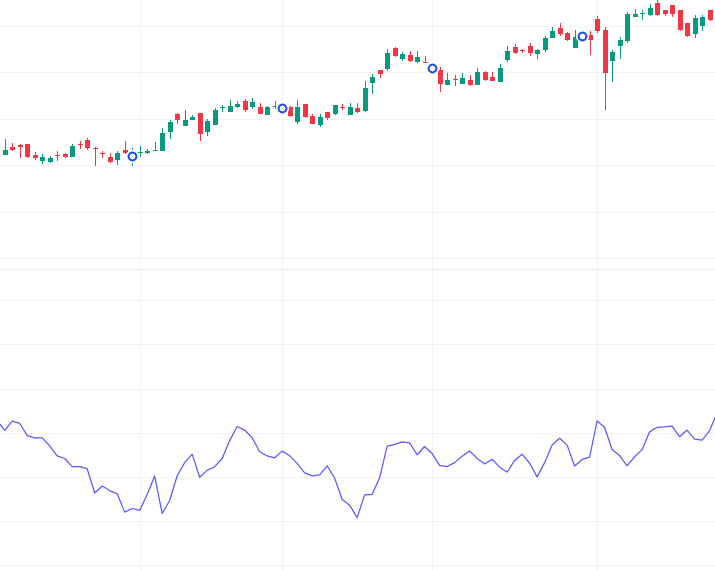
Structural Components
The VHF calculation involves two parts:
- Vertical Movement (Numerator): The difference between the highest high and lowest low over a chosen period.
- Horizontal Movement (Denominator): The sum of absolute differences between consecutive closing prices over the same period.
Formula:
VHF = {Highest\ High – Lowest\ Low}{sum |Close_t – Close_{t-1}|} ]
- High VHF values: Indicate strong directional movement (trending market).
- Low VHF values: Suggest sideways or consolidating conditions.
Distinctive Attributes
- Trend vs. Range Detection: Separates trending phases from consolidations.
- Adaptive Application: Works across multiple timeframes and asset classes.
- Noise Filtering: Focuses on directional consistency rather than minor fluctuations.
- Guidance Role: Suggests whether trend‑following or mean‑reversion tools are more appropriate.
- Cross‑Market Utility: Effective in equities, forex, commodities, and indices.
Market Psychology Reflected
- High VHF Readings: Show strong conviction among traders, with price moving consistently in one direction.
- Low VHF Readings: Reflect indecision, where buyers and sellers balance out, leading to sideways action.
- Falling VHF: Often signals weakening momentum and potential consolidation.
This dynamic mirrors the collective behavior of market participants, offering insight into whether trends are sustainable or fading.
Analytical Considerations
- VHF is best used as a filter, guiding traders on which type of strategy to apply.
- It does not generate direct buy/sell signals but complements other indicators.
- Traders often combine it with moving averages, RSI, Bollinger Bands, or MACD for layered confirmation.
- Sudden volatility spikes can distort readings, requiring cautious interpretation.
Contextual Importance
- Strategy Selection: Helps traders avoid applying trend‑following tools in range‑bound markets.
- Risk Awareness: Reduces the chance of misaligned trades by clarifying market conditions.
- Trend Confirmation: High values validate strong directional moves.
- Reversal Alerts: Declining values may indicate a trend is losing strength.
Final Insight
The Vertical Horizontal Filter is a practical tool that helps traders adapt their approach to prevailing market conditions. By distinguishing between trending and range‑bound phases, it reduces the risk of applying the wrong strategy at the wrong time. Its simplicity and effectiveness make it valuable for both short‑term and long‑term traders. When paired with momentum or volatility‑based indicators, VHF enhances accuracy and confidence, providing a disciplined framework for navigating bullish and bearish markets.
