

The Stochastic Momentum Index (SMI) is an advanced momentum tool designed to improve upon the traditional stochastic oscillator. By measuring the closing price relative to the midpoint of the recent trading range, it provides a smoother and more reliable view of momentum. Unlike the classic stochastic, which can be highly volatile, SMI applies multiple layers of smoothing and interpolation techniques to reduce noise and deliver clearer signals.
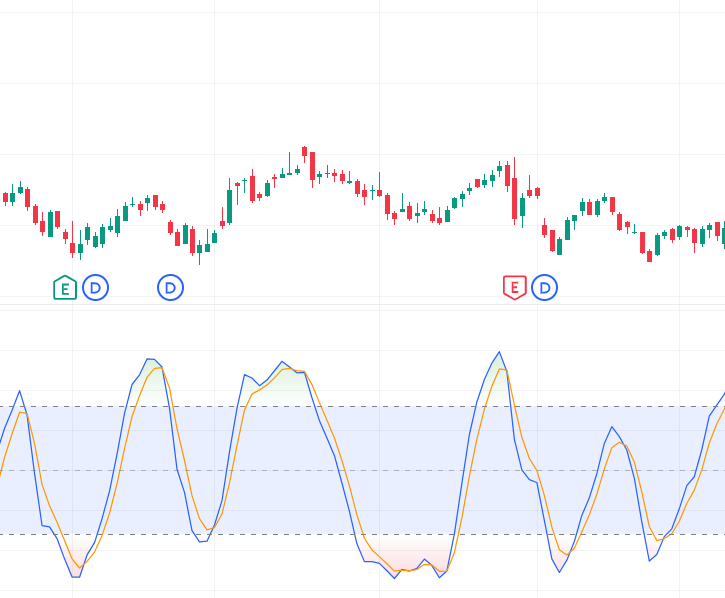
Structural Components
The SMI calculation focuses on price distance from the median of the trading range:
SMI = {Close – Median Price}/{(High – Low)/2} *100 ]
- Close: The most recent closing price.
- Median Price: Midpoint between the high and low of the look‑back period.
- High/Low Range: Defines the boundaries of price movement.
- Smoothing Layers: Multiple moving averages are applied to stabilize the output.
- Interpolation Enhancements: Further refine the curve, minimizing erratic fluctuations.
Values typically oscillate between +100 and ‑100, with zero acting as the centerline.
Distinctive Attributes
- Smooth Momentum Signals: Provides cleaner readings compared to traditional stochastic oscillators.
- Extreme Zone Detection: Identifies overbought and oversold conditions with greater accuracy.
- Trend Strength Analysis: Measures bullish and bearish momentum relative to the midpoint.
- Reduced Whipsaws: Interpolation minimizes false reversals.
- Divergence Alerts: Highlights weakening trends when price and momentum diverge.
- Responsive Yet Stable: Reacts quickly to changes while maintaining smoothness.
Market Psychology Reflected
- Positive Readings Above Zero: Indicate bullish conviction and sustained buying pressure.
- Negative Readings Below Zero: Suggest bearish dominance and selling strength.
- Extreme Values (+80 or ‑80): Signal potential exhaustion zones where reversals may occur.
- Divergence Patterns: Reveal crowd hesitation when price continues in one direction but momentum fails to confirm.
This dynamic captures how traders perceive strength and weakness in market sentiment.
Contextual Importance
- Momentum Confirmation: Validates whether price action supports bullish or bearish sentiment.
- Reversal Alerts: Detects weakening momentum before price shifts occur.
- Noise Filtering: Reduces false signals caused by random volatility spikes.
- Decision Support: Provides smoother signals that improve confidence in analysis.
Final Insight
The Stochastic Momentum Index is a refined oscillator that blends speed, smoothness, and reliability. By applying multiple smoothing layers and interpolation, it reduces noise while maintaining responsiveness, making it far more dependable than the classic stochastic. Its ability to highlight momentum strength, detect reversals, and filter out false signals makes it a valuable tool across all financial markets. For traders seeking consistency and clarity in momentum analysis, the SMI offers a robust framework to interpret bullish and bearish conditions with confidence.
