

Introduction
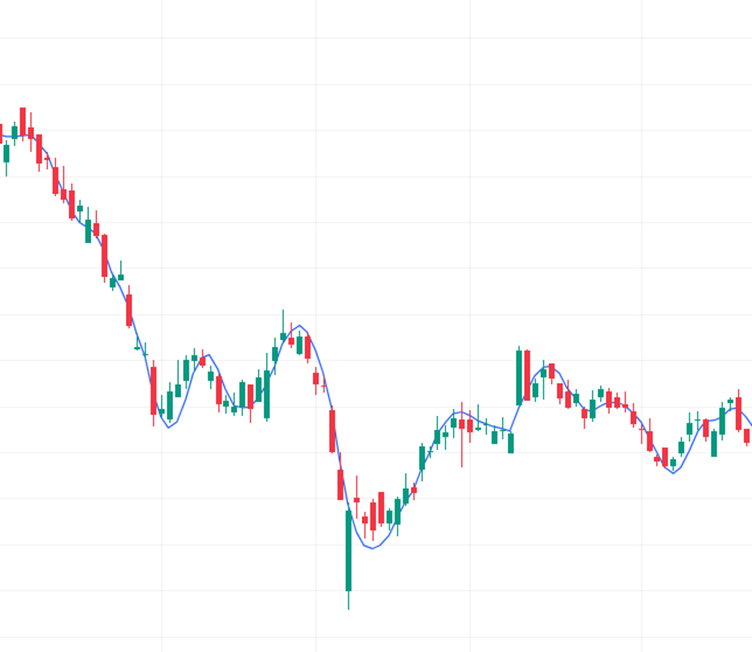
The Hull Moving Average (HMA), created by Alan Hull, is a trend-following indicator designed to overcome the limitations of traditional moving averages. Standard averages like SMA and EMA often suffer from lag, making them slow to react to price changes. HMA reduces this lag while maintaining smoothness, giving traders a more responsive and reliable view of market trends and reversals.
Structural Framework
The HMA is calculated using a unique combination of Weighted Moving Averages (WMA):
[ HMA = WMA\big(2* WMA({n}/{2}) – WMA(n), sqrt{n}\big) ]
Where:
- n → chosen period length
- WMA → Weighted Moving Average
This formula emphasizes recent price data while smoothing the line to avoid excessive noise, resulting in a moving average that reacts quickly to genuine market shifts.
Distinctive Features
The Hull Moving Average offers several qualities that make it stand out:
- Reduced Lag → Reacts faster to price changes compared to SMA or EMA.
- Smoothness → Produces a clean curve without excessive whipsaws.
- Trend Clarity → Highlights bullish and bearish phases with precision.
- Versatility → Effective across multiple timeframes and asset classes.
- Integration Friendly → Can be paired with oscillators like RSI or MACD for confirmation.
Benefits for Traders
The HMA provides practical advantages in trading analysis:
- Trend Recognition → Price consistently above HMA suggests bullish sentiment, while price below indicates bearish bias.
- Disciplined Entries & Exits → Crossovers between price and HMA generate reliable buy/sell signals.
- Risk Control → Filters out false signals by reducing noise, improving trade discipline.
- Reversal Awareness → Its responsiveness helps detect early trend changes.
- Analytical Synergy → Works well with breakout strategies, Fibonacci levels, or volume-based indicators.
Why It Matters
The Hull Moving Average is more than just another smoothing tool—it is a next-generation moving average framework. By reducing lag and enhancing responsiveness, it allows traders to stay aligned with genuine market momentum while avoiding misleading signals. Its adaptability makes it particularly valuable for swing traders and long-term investors who require both clarity and precision.
Conclusion
The Hull Moving Average (HMA) blends responsiveness with smoothness, offering traders a superior way to track trends. Its ability to minimize lag while highlighting genuine momentum makes it a powerful tool for disciplined market analysis. Though best used in combination with other indicators, HMA provides a structured framework for navigating bullish and bearish markets with confidence. For traders seeking an adaptive and reliable approach to trend analysis, the HMA Indicator stands as one of the most effective moving average tools available.
