Sector Analysis
Posted On: March 2, 2026
Consumer Durables Sector Analysis | Feb 2026
Industry Overview
India’s consumer durables sector—covering appliances, electronics, and household goods—contributes ~0.6% of GDP (Economic Survey 2025–26). The sector is driven by rising disposable incomes, urbanization, and demand for smart and energy-efficient products. According to MoSPI’s Index of Industrial Production (IIP, Dec 2025), consumer durables output grew 5.2% year-on-year, reflecting steady recovery.
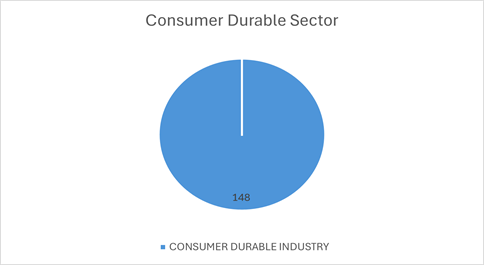
India’s consumer durables sector is composed of 148 companies, all operating within a single unified industry known as the Consumer Durables Industry.
Market Size and Growth Metrics
- Contribution to GDP (FY25): ~0.6% (Economic Survey 2025–26).
- IIP Growth (Dec 2025): 5.2% (MoSPI).
- Exports (FY25): USD 12 billion (OGD datasets).
- Employment Share: ~2% of workforce engaged in consumer durables manufacturing (PLFS, MoSPI).
- Forecast: Market projected to reach USD 150 billion by 2030, with India set to become the fourth-largest consumer durables market globally.
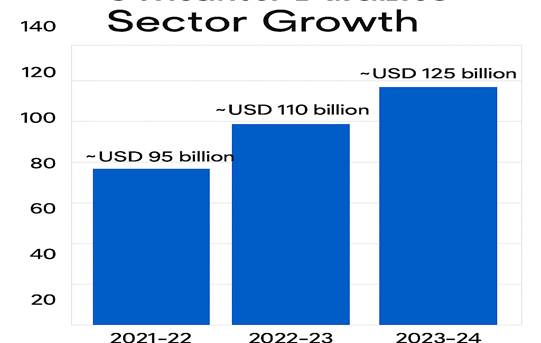
Source: EY
Market Dynamics and Drivers
- Growth Drivers: Rising middle-class demand, rural electrification, digital adoption, and e-commerce penetration.
- Supply Chain: Domestic manufacturing under PLI scheme, reliance on imported components.
- Technological Trends: Smart appliances, IoT-enabled devices, energy-efficient products.
- Consumer Trends: Preference for premium, sustainable, and connected products.
Competitive Landscape
- Major Players: LG, Samsung, Whirlpool, Godrej Appliances, Voltas, Havells.
- New Entrants: Startups in smart appliances and IoT-enabled consumer goods.
- Supplier Power: Moderate; dependence on imported semiconductors and components.
- Buyer Power: High, with consumers demanding affordability and innovation.
- Threat of Substitutes: Growing due to rental models, refurbished goods, and shared economy platforms.
Regulatory Measures
- PLI Scheme (2025): Incentives for domestic manufacturing of electronics and appliances.
- Energy Efficiency Standards (BEE): Mandatory star ratings for appliances.
- Economic Survey 2025–26: Emphasis on boosting domestic production and exports.
- Digital India & ONDC: Expanding e-commerce and digital retail for consumer durables.
Macro Environmental Analysis
- Rising disposable incomes and urbanization driving demand.
- Rural electrification expanding market reach.
- Global supply chain disruptions impacting semiconductor imports.Budget 2026 allocated higher incentives for electronics manufacturing.
- Sustainability focus encouraging energy-efficient appliances.
SWOT Analysis
Strengths
- Growing domestic demand.
- Expanding e-commerce and retail networks.
- Government-backed PLI incentives.
Weaknesses
- Dependence on imported components.
- Price-sensitive consumers limiting premium adoption.
- Low penetration in rural markets.
Opportunities
- Smart and connected appliances.
- Energy-efficient and sustainable products.
- Export growth under global supply chain diversification.
- Expansion of ONDC and digital retail.
Threats
- Global supply chain volatility.
- Competition from low-cost imports.
- Regulatory compliance costs.
- Rapid technological obsolescence.
Future Outlook
- India projected to become the fourth-largest consumer durables market by 2030.
- Market size expected to reach USD 150 billion by 2030.
- Strong growth in smart appliances, IoT devices, and sustainable products.
- Domestic manufacturing under PLI scheme to reduce import dependence.
Conclusion
India’s consumer durables sector is poised for strong growth, supported by rising incomes, urbanization, and government-backed manufacturing incentives. While challenges such as import dependence, price sensitivity, and global supply chain risks remain, the sector’s future is promising with smart, sustainable, and connected products driving expansion under the Viksit Bharat 2047 vision.
Sources
- Ministry of Statistics & Programme Implementation (MoSPI – IIP, Dec 2025),
- Economic Survey 2025–26,
- Open Government Data (OGD) Platform India.
What is xCalData?
xCalData is a Made in India AI powered investment research platform called RHOMB.
Using multilayered neural network, RHOMB analyses over 150+ technical ratios, 150+ candlestick chart patterns and over 40 fundamental ratios of each stock.
RHOMB forecasts the stock price movement for the next few days and determines buy, sell, hold or wait.
How accurate is xCalData?
xCalData publishes the accuracy of the past trades for each stock to enable an informed decision.
Is xCaldata an Algo trading platform?
No, xCalData is not an algotrading platform. User decides when to buy or sell including, we only provide inputs for the decision.
Download the app for further stock level insights: https://open.xcaldata.com/apps/
Checkout the trades and detailed insights in the app

Popular Posts
-
Stock of Interest . August 23, 2024
#HSCL (NSE) Stock Report | 23 Aug 2024
-
Stock of Interest . August 23, 2024
Add Zerodha trading account to xCalData
-
Stock of Interest . August 23, 2024
What is xCalData , how to use it and how accurate is it?
-
Stock of Interest . August 23, 2024
Jurik Moving Average (JMA): A Profit Trading Insight