Sector Analysis
Posted On: March 4, 2026
Indian Construction Materials Sector Analysis | Mar 2026
Industry Overview
India’s construction materials sector is a pillar of infrastructure and housing growth, supplying cement, steel, aggregates, aluminum, and eco-friendly substitutes. The sector contributes ~3.4% of GDP in FY25 (Economic Survey 2025–26). According to the Ministry of Steel, India is the second-largest producer of crude steel globally, while the NITI Aayog Cement Roadmap (2025) highlights India as the second-largest cement producer worldwide.
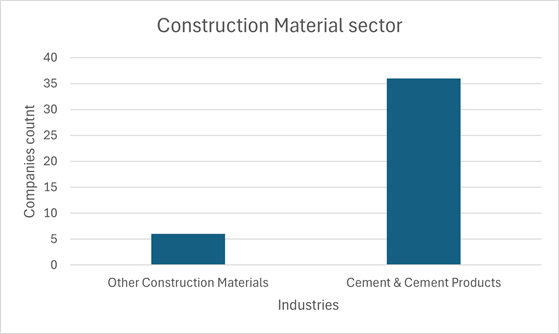
The Construction Materials sector in India is made up of two industries: Cement & Cement Products, which dominates with 36 companies, and Other Construction Materials, which includes 6 companies. Together, these 42 companies form the backbone of India’s construction ecosystem, with cement leading as the primary driver of infrastructure growth, while other materials provide complementary support for specialized building needs.
Market Size and Growth Metrics
- Contribution to GDP (FY25): ~ 3.4% of the GDP
- The industry currently boasts a turnover of $9.5 Bn, making India the world’s 3rd-largest CE market
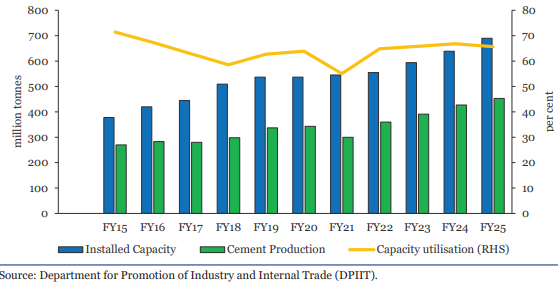
- Cement Production (FY25): ~453 million tonnes
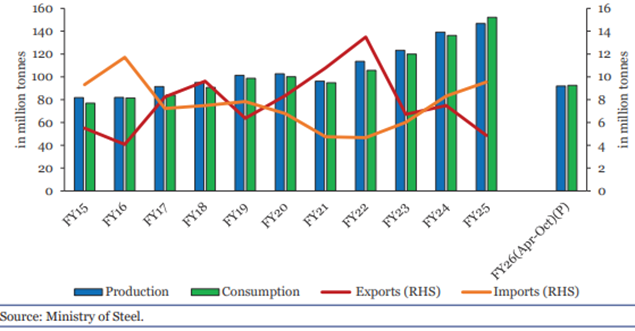
- Fiscal year 2025-26, with crude steel production growing by 11.7 per cent, finished steel production increasing by 10.8 percent, and consumption rising by 7.8 per cent during April-October 2025-26, compared to the corresponding period last year
- India’s construction materials market was valued at $45 billion in 2022 and is expected to grow at a CAGR of 10.6% to reach $82.5 billion by 2028
Steel production ,consumption, Exports and Imports
Installed Capacity, Production and Capacity utilization of cement Industry
Market Dynamics and Drivers
- Growth Drivers: Infrastructure expansion, housing demand, renewable energy projects, smart cities.
- Supply Chain: Raw material extraction, cement and steel plants, distribution networks, retail.
- Technological Trends: Green cement, recycled aggregates, prefabricated materials, digital supply chain.
- Consumer Trends: Preference for sustainable, cost-efficient, and durable materials.
Competitive Landscape
- Major Players: UltraTech Cement, JSW Steel, Tata Steel, Shree Cement, ACC.
- Public Sector: Steel Authority of India (SAIL), National Council for Cement & Building Materials (NCCBM).
- Supplier Power: Moderate; raw material costs influence competitiveness.
- Buyer Power: High, with developers demanding cost efficiency and sustainability.
- Threat of Substitutes: Emerging eco-friendly alternatives (fly ash cement, recycled steel).
Regulatory Measures
- Union Budget 2026: Increased allocation for infrastructure corridors and housing.
- NITI Aayog Cement Decarbonisation Roadmap (2025): Targets net-zero pathways for cement industry.
- National Infrastructure Pipeline (NIP): Boosts demand for cement and steel.
- Economic Survey 2025–26: Highlights construction materials as critical for industrial growth.
Macro Environmental Analysis
- Infrastructure push driving cement and steel demand.
- Budget 2026 emphasized renewable energy and housing.
- Commodity price volatility impacting margins.ESG compliance and sustainability becoming mandatory.
- Digital platforms improving procurement transparency.
SWOT Analysis
Strengths
- Large domestic demand base.
- Strong public and private sector presence.
- Expanding infrastructure pipeline.
Weakness
- Dependence on global commodity prices.
- High carbon footprint of cement and steel.
- Fragmented supply chain in rural areas.
Opportunities
- Green cement and recycled materials.
- Smart city and housing projects.
- Export potential in steel and aluminum.
- Public-private partnerships.
Threats
- Global recession risks.
- Climate change regulations increasing costs.
- Competition from alternative materials.
- Supply chain disruptions.
Future Outlook
- India’s construction materials market was valued at $45 billion in 2022 and is expected to grow at a CAGR of 10.6% to reach $82.5 billion by 2028
- Cement demand expected to grow at 7 CAGR, steel at 9.12CAGR.
- India positioned as a global hub for sustainable construction materials under Viksit Bharat 2047.
Conclusion
India’s construction materials sector is a strategic pillar of infrastructure and housing growth, contributing significantly to GDP. With strong government support, sustainability initiatives, and rising demand, the sector is poised for expansion. Addressing challenges such as carbon emissions, price volatility, and supply chain inefficiencies will be crucial for resilience and competitiveness.
Sources
- Ministry of Steel (2026)
- NITI Aayog Cement Sector Decarbonisation Roadmap (2025)
- Ministry of Statistics & Programme Implementation (MoSPI, 2026)
- Economic Survey 2025–26 (Ministry of Finance).
What is xCalData?
xCalData is a Made in India AI powered investment research platform called RHOMB.
Using multilayered neural network, RHOMB analyses over 150+ technical ratios, 150+ candlestick chart patterns and over 40 fundamental ratios of each stock.
RHOMB forecasts the stock price movement for the next few days and determines buy, sell, hold or wait.
How accurate is xCalData?
xCalData publishes the accuracy of the past trades for each stock to enable an informed decision.
Is xCaldata an Algo trading platform?
No, xCalData is not an algotrading platform. User decides when to buy or sell including, we only provide inputs for the decision.
Download the app for further stock level insights: https://open.xcaldata.com/apps/
Checkout the trades and detailed insights in the app

Popular Posts
-
Stock of Interest . August 23, 2024
#HSCL (NSE) Stock Report | 23 Aug 2024
-
Stock of Interest . August 23, 2024
Add Zerodha trading account to xCalData
-
Stock of Interest . August 23, 2024
What is xCalData , how to use it and how accurate is it?
-
Stock of Interest . August 23, 2024
Jurik Moving Average (JMA): A Profit Trading Insight