Sector Analysis
Posted On: February 25, 2026
Indian FMCG Sector Analysis |Feb 2026
Industry Overview
India’s FMCG sector is the fourth-largest contributor to GDP (~5%) and a major source of employment, directly engaging ~3 million people. It spans packaged foods, beverages, personal care, household products, and OTC healthcare.
- Market Size (FY25): ~₹55 trillion.
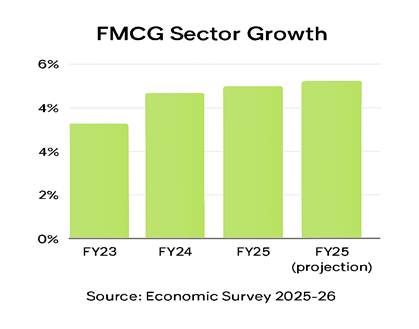
- Growth Outlook: 6–7% CAGR projected through FY27.
- Rural Consumption: ~36% of FMCG sales, supported by government schemes and rural electrification.
- Urban Consumption: Premiumization, organized retail, and e-commerce driving growth.
Market Size and Growth Metrics
- Packaged Foods: Largest segment (~45% of FMCG).
- Personal Care: ~20% share, growing at 8–9% CAGR.
- Beverages: ~10% share, led by dairy and soft drinks.
- Household Care: ~7% share.
- Forecast: FMCG market projected to reach ₹70 trillion by FY27.
Market Dynamics and Drivers
- Growth Drivers: GST reforms, rising disposable incomes, rural penetration, digital retail boom.
- Supply Chain: Expanding distribution networks, cold chain investments, e-commerce logistics.
- Technological Trends: AI-driven demand forecasting, digital payments, D2C platforms.
- Consumer Trends: Premiumization, health & wellness products, sustainable packaging.
Competitive Landscape
- Large Players: HUL, ITC, Nestlé India, Britannia, Dabur, Marico, Godrej Consumer Products.
- Emerging Startups: D2C brands in snacks, personal care, organic foods.
- Buyer Power: High, with consumers demanding affordability and sustainability.
- Supplier Power: Moderate, impacted by commodity price volatility.
Regulatory Measures
- GST Reforms (2025): Reduced rates on processed foods, dairy, and marine products.
- FSSAI Regulations (2025): Stricter labeling, expiry dates, nutrition transparency, and packaging standards.
- Consumer Affairs Ministry: Monitoring retail prices and enforcing Packaged Commodities Rules.
- Economic Survey 2025–26: FMCG highlighted as a driver of consumption-led growth.
Macro Environmental Analysis
India’s FMCG sector is seeing consumption recovery supported by moderating food inflation, while digital retail channels like e-commerce and quick-commerce are expanding reach. Rural demand is strengthening through schemes such as PM-GKAY and rural electrification, and climate policy is driving adoption of sustainable packaging and ESG disclosures
SWOT Analysis – Indian FMCG Sector
Strengths
- Large domestic market.
- Strong distribution networks.
- Policy supports GST reforms.
- Expanding digital retail ecosystem.
Weaknesses
- High dependence on rural demand cycles.
- Commodity price volatility.
- Intense competition reducing margins.
Opportunities
- Premiumization and health-focused products.
- Rural market expansion.
- Sustainable packaging and ESG compliance.
- Export potential in processed foods.
Threats
- Global commodity shocks.
- Inflationary pressures.
- Regulatory compliance costs.
- Competition from global FMCG majors.
Future Outlook
- FMCG market projected to reach ₹70 trillion by FY27.
- Rural demand is expected to drive 40% of incremental growth.
- Digital retail and D2C brands to reshape distribution.
- ESG and sustainability to become mainstream.
Conclusion
India’s FMCG sector is positioned for steady expansion, supported by GST reforms, rural demand, and digital retail growth. While risks from inflation and global commodity volatility remain, the sector’s resilience and adaptability make it a core driver of India’s consumption economy
Sources
- Economic Survey 2025–26 – Comprehensive government report highlighting FMCG as a driver of consumption-led growth, rural demand, and GST reforms.
- Ministry of Consumer Affairs, Food & Public Distribution – Official notifications on retail price monitoring, Packaged Commodities Rules, and GST-linked revisions to FMCG pricing.
- FSSAI (Food Safety and Standards Authority of India) – Updated 2025 regulations on labelling, expiry dates, nutrition transparency, and packaging standards for FMCG products.
- Press Information Bureau (PIB) – Government press releases on GST reforms, exports, and consumption trends impacting FMCG.
What is xCalData?
xCalData is a Made in India AI powered investment research platform called RHOMB.
Using multilayered neural network, RHOMB analyses over 150+ technical ratios, 150+ candlestick chart patterns and over 40 fundamental ratios of each stock.
RHOMB forecasts the stock price movement for the next few days and determines buy , sell , hold or wait.
How accurate is xCalData?
xCalData publishes the accuracy of the past trades for each stock to enable an informed decision.
Is xCaldata an Algo trading platform?
No, xCalData is not an algotrading platform. User decides when to buy or sell including, we only provide inputs for the decision.
Download the app for further stock level insights: https://open.xcaldata.com/apps/
Checkout the trades and detailed insights in the app

Popular Posts
-
Stock of Interest . August 23, 2024
#HSCL (NSE) Stock Report | 23 Aug 2024
-
Stock of Interest . August 23, 2024
Add Zerodha trading account to xCalData
-
Stock of Interest . August 23, 2024
What is xCalData , how to use it and how accurate is it?
-
Stock of Interest . August 23, 2024
Jurik Moving Average (JMA): A Profit Trading Insight