Sector Analysis
Posted On: March 3, 2026
Indian Forest Materials Sector Analysis | Mar 2026
Industry Overview
India’s forest materials sector includes timber, bamboo, pulpwood, paper, packaging, and non-timber forest products (NTFPs) such as resins, gums, and medicinal plants. Forests cover ~25.17% of India’s geographical area (FSI, ISFR 2023).
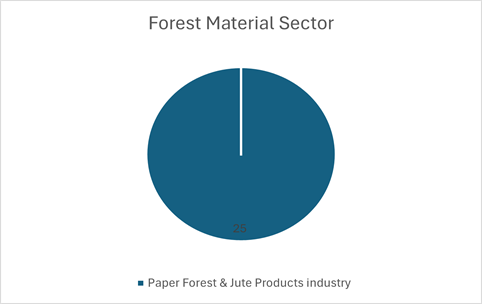
The Forest Materials sector in India comprises 25 companies, all grouped under the single category of Paper, Forest, and Jute Products.
Market Size and Growth Metrics
- Forest Cover (2023): ~ 25.17 % of geographical area (FSI, MoEFCC).
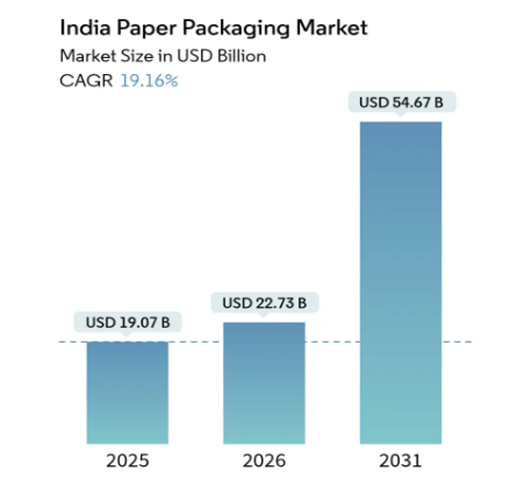
- India paper packaging market size in 2026 is estimated at USD 22.73 billion, growing from 2025 value of USD 19.07 billion with 2031 projections showing USD 54.67 billion, growing at 19.16% CAGR over 2026-2031
- The India Jute Bags Market was valued at USD 300.12 Million in 2024, and is expected to reach USD 392.20 Million by 2030, rising at a CAGR of 4.52%
Source: Morder Intelligence
Market Dynamics and Drivers
- Growth Drivers: Rising demand for sustainable materials, bamboo-based industries, eco-friendly packaging, herbal medicines.
- Supply Chain: Forest produce collection, processing industries, cooperatives, and exports.
- Technological Trends: Bamboo composites, bio-resins, digital forest produce trading, sustainable forestry practices.
- Consumer Trends: Preference for certified timber, eco-friendly furniture, herbal medicines, and biodegradable packaging.
Competitive Landscape
- Major Players: ITC (paper & pulp), Century Plyboards, State Forest Development Corporations.
- Public Sector: MoEFCC, State Forest Departments, TRIFED (Tribal Cooperative Marketing Development Federation).
- Supplier Power: Moderate; forest-dependent communities are key suppliers.Buyer Power: Increasing, with demand for certified and sustainable products.
- Threat of Substitutes: Synthetic materials, plastics, and imported timber.
Regulatory Measures
- Forest Rights Act (2006): Grants rights to forest-dependent communities.
- National Bamboo Mission (2025): Promotes bamboo cultivation and industry.
- Easing of Forest Conservation Rules (Jan 2026): The Ministry of Environment, Forests and Climate Change (MoEF&CC) amended the Van (Sanrakshan Evam Samvardhan) Adhiniyam, 1980, to allow private entities to undertake commercial plantations in forest areas without paying the Net Present Value (NPV) and Compensatory Afforestation (CA) levies.
- Revision of Raw Jute Stock Limits (Jan 2026): To prevent hoarding, the Jute Commissioner revised stock limits under the Jute and Jute Textiles Control Order, 2016.
Macro Environmental Analysis
- Forest sector linked to rural employment and ecological sustainability.
- Budget 2026 increased allocation for bamboo mission and eco-friendly packaging.
- Climate change risks impacting forest productivity.Export potential rising for bamboo, herbal medicines, and eco-friendly materials.
- Digital platforms improving transparency in forest produce trade.
SWOT Analysis
Strengths
- Large forest cover and biodiversity.
- Strong rural livelihood base.
- Expanding bamboo and herbal industries.
Weaknesses
- Dependence on traditional collection methods.
- Limited processing infrastructure.
- Illegal logging and forest degradation.
Opportunities
- Eco-friendly packaging and furniture.
- Bamboo composites and bio-resins.
- Export growth in herbal medicines and forest products.
- Public-private partnerships in forest-based industries.
Threats
- Climate change affecting forest productivity.
- Competition from synthetic substitutes.
- Regulatory delays in forest clearances.
- Overexploitation of minor forest produce.
Future Outlook
- India paper packaging market size in 2026 is estimated at USD 22.73 billion, growing from 2025 value of USD 19.07 billion with 2031 projections showing USD 54.67 billion, growing at 19.16% CAGR over 2026-2031
- Herbal medicines and eco-friendly packaging to drive exports.
- Focus on sustainability, digital trade platforms, and rural empowerment.
Conclusion
India’s forest materials sector is vital for sustainability and rural livelihoods, contributing to GDP, exports, and ecological balance. With government-backed initiatives like the National Bamboo Mission and TRIFED support, the sector is poised for growth. Addressing challenges such as illegal logging, infrastructure gaps, and climate risks will be crucial for resilience under the Viksit Bharat 2047 vision.
Sources
Forest Survey of India (ISFR 2023)
Ministry of Environment, Forest & Climate Change (MoEFCC, 2026)
National Data & Analytics Platform (NDAP).
Morder Intelligence
What is xCalData?
xCalData is a Made in India AI powered investment research platform called RHOMB.
Using multilayered neural network, RHOMB analyses over 150+ technical ratios, 150+ candlestick chart patterns and over 40 fundamental ratios of each stock.
RHOMB forecasts the stock price movement for the next few days and determines buy, sell, hold or wait.
How accurate is xCalData?
xCalData publishes the accuracy of the past trades for each stock to enable an informed decision.
Is xCaldata an Algo trading platform?
No, xCalData is not an algotrading platform. User decides when to buy or sell including, we only provide inputs for the decision.
Download the app for further stock level insights: https://open.xcaldata.com/apps/
Checkout the trades and detailed insights in the app

Popular Posts
-
Stock of Interest . August 23, 2024
#HSCL (NSE) Stock Report | 23 Aug 2024
-
Stock of Interest . August 23, 2024
Add Zerodha trading account to xCalData
-
Stock of Interest . August 23, 2024
What is xCalData , how to use it and how accurate is it?
-
Stock of Interest . August 23, 2024
Jurik Moving Average (JMA): A Profit Trading Insight