Sector Analysis
Posted On: February 26, 2026
Indian Healthcare Sector Analysis |Feb 2026
Industry Overview
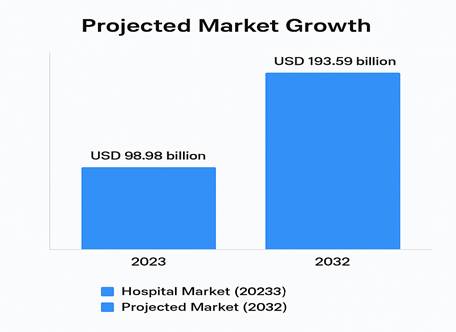
India’s healthcare industry is valued at USD 98.98 billion in 2023 and is projected to grow at a CAGR of 8% from 2024–2032, reaching USD 193.59 billion by 2032. Public expenditure on healthcare is expected to be 1.9% of GDP in FY26, compared to 2.5% in FY25. The sector is driven by hospital infrastructure expansion, medical devices, pharmaceuticals, and digital health adoption.
Market Size and Growth Metrics
- Hospital Market (2023): USD 98.98 billion
- Projected Market (2032): USD 193.59 billion
- Corporate Healthcare Growth (FY25–26): ~15% YoY, driven by ARPOB (Average Revenue per Occupied Bed) and new bed additions.
- Healthcare Workforce Needs (by 2025): 3M additional hospital beds, 1.54M doctors, 2.4M nurses (MoHFW Annual Report).
Market Dynamics and Drivers
- Growth Drivers: Rising chronic disease burden, medical tourism, digital health adoption, insurance penetration.
- Supply Chain: Expansion of hospital infrastructure, medical devices, and telemedicine platforms.
- Technological Trends: AI-driven diagnostics, telehealth, electronic health records, robotic surgeries.
- Consumer Trends: Affordable healthcare demand, preventive health check-ups, wellness services.
Competitive Landscape
- Major Players: Apollo Hospitals, Fortis Healthcare, Max Healthcare, Narayana Health.
- New Entrants: Digital health startups, telemedicine platforms, health-tech innovators.
- Supplier Power: Moderate; dependence on imported medical devices persists.
- Buyer Power: High, with patients demanding affordability and quality.
- Threat of Substitutes: Growing due to home healthcare, wellness apps, and preventive medicine.
Regulatory Measures
- MoHFW Annual Report (2024–25): Strengthening National Health Mission (NHM) and National Urban Health Mission (NUHM).
- Ayushman Bharat Digital Mission (ABDM): Expanding digital health records and telemedicine.
- Economic Survey 2025–26: Healthcare expenditure at 1.9% of GDP, with calibrated fiscal strategy.
- NITI Aayog Vision 2047: Strategic pillars for universal healthcare access and infrastructure expansion.
Macro Environmental Analysis
- India’s healthcare demand is rising due to aging population and chronic diseases.
- Private equity investment in healthcare surged to ₹4,900 crore (USD 572M) across 33 deals in Q2 CY25.
- Government initiatives expanding rural healthcare infrastructure and digital health adoption.
- Medical tourism continues to grow, with India offering cost-effective treatments compared to global peers.
SWOT Analysis
Strengths
- Large domestic market with rising healthcare demand.
- Strong hospital networks and medical tourism appeal.
- Government-backed schemes (Ayushman Bharat, NHM).
Weaknesses
- Low public health expenditure (~1.9% of GDP).
- Shortage of healthcare professionals and hospital beds.
- Dependence on imported medical devices.
Opportunities
- Expansion of telemedicine and digital health.
- Rising demand for preventive healthcare and wellness.
- Growth in medical devices and diagnostics.
- Insurance penetration expanding healthcare access.
Threats
- Rising costs of healthcare delivery.
- Regulatory compliance challenges.
- Global competition in medical tourism.
- Inequitable access between urban and rural areas.
Future Outlook
- Healthcare sector projected to reach USD 193.59 billion by 2032.
- Corporate healthcare expected to grow at 15% YoY in FY26.
- India aims to achieve universal healthcare coverage by 2047 under NITI Aayog’s Viksit Bharat Vision.
- Digital health adoption and medical devices market expansion will be key growth drivers.
Conclusion
India’s healthcare sector is on a strong growth trajectory, supported by government initiatives, private investment, and rising demand for affordable healthcare. While challenges such as low public expenditure, workforce shortages, and regulatory compliance remain, the sector’s future is promising with digital health, medical tourism, and infrastructure expansion driving momentum.
Sources
- Ministry of Health & Family Welfare (MoHFW) – Annual Report 2024–25
Provides data on hospital infrastructure, workforce requirements, and National Health Mission (NHM) initiatives. - Economic Survey 2025–26 (Government of India, Ministry of Finance)
Official statistics on healthcare expenditure as a percentage of GDP and fiscal allocations. - Press Information Bureau (PIB) – Healthcare Updates 2025–26
Government press releases on healthcare investments, medical tourism, and digital health adoption. - NITI Aayog – Vision 2047 Working Papers
Long-term projections for universal healthcare coverage and infrastructure expansion.
- Ayushman Bharat Digital Mission (ABDM)
- National Health Mission (NHM) & National Urban Health Mission (NUHM)
- Department of Pharmaceuticals & MoHFW Budget Allocations (FY25–26)
- Private Equity Investment Reports (PIB releases, 2025)
What is xCalData?
xCalData is a Made in India AI powered investment research platform called RHOMB.
Using multilayered neural network, RHOMB analyses over 150+ technical ratios, 150+ candlestick chart patterns and over 40 fundamental ratios of each stock.
RHOMB forecasts the stock price movement for the next few days and determines buy, sell, hold or wait.
How accurate is xCalData?
xCalData publishes the accuracy of the past trades for each stock to enable an informed decision.
Is xCaldata an Algo trading platform?
No, xCalData is not an algotrading platform. User decides when to buy or sell including, we only provide inputs for the decision.
Download the app for further stock level insights: https://open.xcaldata.com/apps/
Checkout the trades and detailed insights in the app

Popular Posts
-
Stock of Interest . August 23, 2024
#HSCL (NSE) Stock Report | 23 Aug 2024
-
Stock of Interest . August 23, 2024
Add Zerodha trading account to xCalData
-
Stock of Interest . August 23, 2024
What is xCalData , how to use it and how accurate is it?
-
Stock of Interest . August 23, 2024
Jurik Moving Average (JMA): A Profit Trading Insight