Sector Analysis
Posted On: March 3, 2026
Indian Metals & Mining Sector Analysis | Mar 2026
Industry Overview
India’s metals and mining sector is a critical driver of industrial growth, supplying raw materials for steel, aluminum, copper, cement, and energy industries. The sector contributes ~2.5% of GDP in FY25 (Economic Survey 2025–26). According to the Ministry of Mines, India is among the top producers of iron ore, bauxite, and manganese. The Union Budget 2026 emphasized rare earth and critical minerals to support manufacturing and infrastructure development.
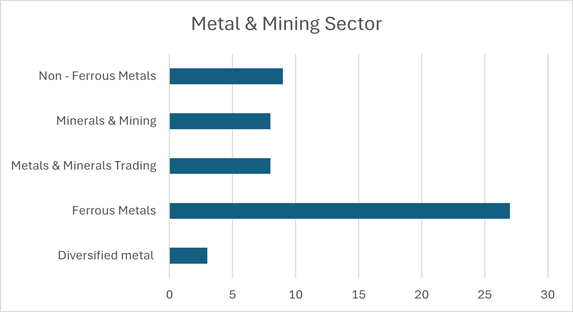
India’s Metals & Mining sector consists of 55 companies across five categories: 3 in diversified metals, 27 in ferrous metals, 8 in metals and minerals trading, 8 in minerals and mining, and 9 in non‑ferrous metals. Ferrous metals dominate the sector, while non‑ferrous and mining firms supply critical inputs for infrastructure and renewable energy
Market Size and Growth Metrics
- Contribution to GDP (FY25): 2.5%
- Production (FY25):
Iron Ore: ~250 million tonnes.
Bauxite: ~35 million tonnes.
Coal: ~900 million tonnes (MoM/OGD).
- Mica, Coal & Other Ores, Minerals including processed minerals exports increased by 6.95% from US$ 4.68 Billion in FY 2023-24 (April-March) to US$ 5.01 Billion in FY 2024-25 (April-March).
- India’s current steel capacity, projected to reach 300 MT by 2030, at a CAGR of 9.4%
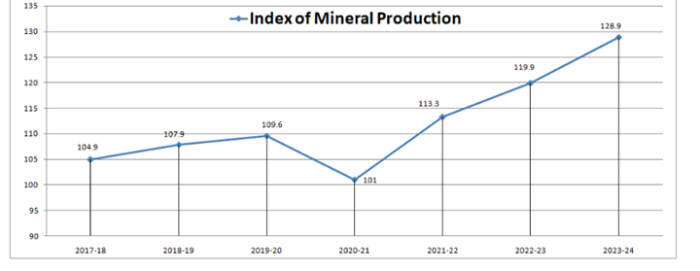
Source: Ministry of Mines
Market Dynamics and Drivers
- Growth Drivers: Infrastructure expansion, renewable energy demand, rare earth minerals, and government incentives.
- Supply Chain: Mining companies, smelters, steel plants, logistics, and exports.
- Technological Trends: Automation in mining, AI-driven exploration, sustainable mining practices.
- Consumer Trends: Rising demand for steel, aluminum, and copper in housing, transport, and renewable energy.
Competitive Landscape
- Major Players: NMDC, Hindustan Copper, Coal India, Hindalco.
- Public Sector: Steel Authority of India (SAIL), National Aluminium Company (NALCO).
- Supplier Power: Moderate; raw material prices affect competitiveness.
- Buyer Power: High, with steel and energy industries as major clients.
- Threat of Substitutes: Limited, though recycling and alternative materials are emerging.
Regulatory Measures
- MMDR Act (Mines and Minerals Development & Regulation): Governs mining leases and auctions.
- Union Budget 2026: Announced Rare Earth Corridors in Odisha, Kerala, Andhra Pradesh, and Tamil Nadu.
- National Mineral Policy (2019): Focus on transparency and sustainability.
- Economic Survey 2025–26: Emphasis on critical minerals for energy transition.
Macro Environmental Analysis
- Mining sector growth tied to infrastructure and manufacturing demand.
- Budget 2026 increased allocation for rare earth and critical minerals.
- Global commodity price volatility impacting margins.
- Climate change risks driving demand for sustainable mining practices.
- Export opportunities rising in rare earths and aluminum.
SWOT Analysis
Strengths
- Rich mineral reserves.
- Strong public sector presence.
- Government-backed reforms and incentives.
Weaknesses
- Dependence on global commodity prices.
- Environmental and regulatory hurdles.
- Infrastructure bottlenecks in logistics.
Opportunities
- Rare earth corridors and critical minerals.
- Renewable energy and EV demand.
- Public-private partnerships (PPP).
- Export diversification.
Threats
- Global price volatility.
- Climate risks affecting mining operations.
- Regulatory delays in clearances.
- Competition from global producers.
Future Outlook
- India’s current steel capacity, projected to reach 300 MT by 2030, at a CAGR of 9.4%
- The global metals and mining sector is projected to experience strong, consistent growth through 2030, with various segments forecasted to grow at a Compound Annual Growth Rate (CAGR) between 3.6% and 11%..
- Infrastructure and renewable energy to drive demand for steel, aluminum, and copper.
- Focus on sustainability, automation, and global competitiveness.
Conclusion
India’s metals and mining sector remains a critical driver of industrial and infrastructure growth, supported by government reforms, rare earth corridor development, and sustainability initiatives. Looking ahead to Viksit Bharat 2047, the industry’s expansion will depend on its ability to mitigate price volatility, environmental risks, and regulatory delays. By embedding innovation, sustainability, and strong governance, the sector can position itself as a resilient pillar of India’s long-term economic transformation and global competitiveness.
Sources
- Ministry of Mines (2026)
- Union Budget 2026 highlights (EY India)
- Economic Survey 2025–26
- National Data & Analytics Platform (NDAP).
- International Energy Agency
What is xCalData?
xCalData is a Made in India AI powered investment research platform called RHOMB.
Using multilayered neural network, RHOMB analyses over 150+ technical ratios, 150+ candlestick chart patterns and over 40 fundamental ratios of each stock.
RHOMB forecasts the stock price movement for the next few days and determines buy, sell, hold or wait.
How accurate is xCalData?
xCalData publishes the accuracy of the past trades for each stock to enable an informed decision.
Is xCaldata an Algo trading platform?
No, xCalData is not an algotrading platform. User decides when to buy or sell including, we only provide inputs for the decision.
Download the app for further stock level insights: https://open.xcaldata.com/apps/
Checkout the trades and detailed insights in the app

Popular Posts
-
Stock of Interest . August 23, 2024
#HSCL (NSE) Stock Report | 23 Aug 2024
-
Stock of Interest . August 23, 2024
Add Zerodha trading account to xCalData
-
Stock of Interest . August 23, 2024
What is xCalData , how to use it and how accurate is it?
-
Stock of Interest . August 23, 2024
Jurik Moving Average (JMA): A Profit Trading Insight