Sector Analysis
Posted On: February 26, 2026
Indian Pharmaceutical Industry Analysis | Feb 2026
Industry Overview
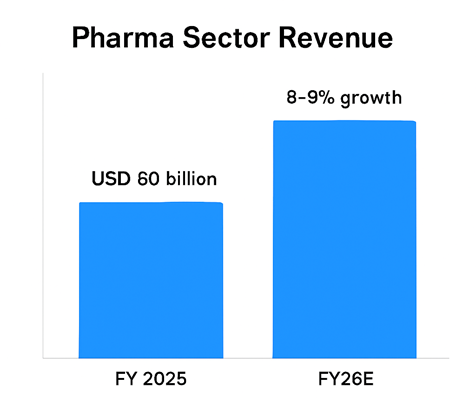
India’s pharmaceutical industry is valued at USD 60 billion in FY25 and is projected to grow at 8–9% in FY26, driven by generics, biosimilars, and vaccines. India ranks 3rd globally by volume and 14th by value, supplying 20% of the world’s generics and exporting to 200+ countries including the US, EU, and Japan.
Market Size and Growth Metrics
- FY25 Market Size: USD 55–60 billion
- Exports (FY25): USD 30.47 billion (Drugs & Pharmaceuticals)
- Domestic Market (FY24): USD 23.5 billion
- Growth Forecast: 8–9% CAGR in FY26; projected USD 120–130 billion by 2030
Market Dynamics and Drivers
- Growth Drivers: Generics, biosimilars, vaccines, chronic disease therapies.
- Supply Chain: Strong API base but dependence on imports (China).
- Technological Trends: Biologics, biosimilars, AI-driven drug discovery, digital health.
- Consumer Trends: Affordable medicines, medical tourism, chronic disease management.
Competitive Landscape
- Major Players: Sun Pharma, Dr. Reddy’s, Cipla, Lupin, Zydus Lifesciences.
- New Entrants: Biotech startups in biosimilars and precision medicine.
- Supplier Power: Moderate; API dependence increases vulnerability.
- Buyer Power: High, with global clients demanding cost efficiency and compliance.
- Threat of Substitutes: Rising due to biologics, biosimilars, and digital therapeutics.
Regulatory Measures
- CDSCO Notifications (2026): Amendments in Drugs Rules, updated prescribing guidelines, medical device testing regulations.
- New Drug Approvals: CDSCO approved multiple new drugs in 2025–26.
- Government Initiatives: Increased budget allocation to pharma R&D, incentives for innovation and supply chain resilience.
Macro Environmental Analysis
- India supplies medicines to 200+ countries.
- Exports: USD 30.47 billion in FY25, with strong growth in regulated markets.
- Medical Devices Market: Projected to reach INR 12 trillion by 2030.
- Innovation Push: CRDMO industry projected at INR 1.2 trillion by FY28.
- Government Support: 29% YoY increase in Department of Pharmaceuticals allocation (FY26).
SWOT Analysis
Strengths
- Global leadership in generics and vaccines.
- Cost-efficient manufacturing and strong R&D base.
- Large domestic market with rising healthcare access.
Weaknesses
- Heavy reliance on API imports.
- Pricing pressure in developed markets.
- Regulatory complexity and compliance costs.
Opportunities
- Biosimilars and biologics expansion.
- Growth in medical devices and CRDMO services.
- Rising demand in emerging markets.
- AI-driven drug discovery.
Threats
- Geopolitical risks and trade tensions.
- Stricter global regulatory standards (FDA, EMA).
- Competition from other low-cost producers.
- cliffs and pricing caps.
Future Outlook
- Pharma exports expected to grow at double-digit rates in FY26–27.
- Market size projected at USD 120–130 billion by 2030.
- India aims to scale into a USD 450–500 billion healthcare powerhouse by 2047 (NITI Aayog Vision).
- Focus shifting toward innovation, biosimilars, and global supply chain resilience.
Conclusion
India’s pharmaceutical industry remains a global leader in generics and vaccines, while steadily transitioning toward innovation-driven growth. With strong government support, rising exports, and expanding domestic demand, the sector is poised for sustained expansion. However, risks such as API dependence, pricing pressure, and regulatory compliance must be managed carefully to maintain competitiveness.
Sources
- Department of Pharmaceuticals (DoP), Ministry of Chemicals & Fertilizers – Annual reports and budget allocations for FY25–26.
- Central Drugs Standard Control Organization (CDSCO) – Notifications on Drugs & Cosmetics Rules, new drug approvals, and medical device regulations (2025–26).
- Press Information Bureau (PIB)
- Union Budget 2026 (Ministry of Finance)
- Pharmaceuticals Export Promotion Council of India (Pharmexcil)
- Directorate General of Commercial Intelligence and Statistics (DGCI&S)
- NITI Aayog Vision 2047 – Long-term projections for India’s healthcare
What is xCalData?
xCalData is a Made in India AI powered investment research platform called RHOMB.
Using multilayered neural network, RHOMB analyses over 150+ technical ratios, 150+ candlestick chart patterns and over 40 fundamental ratios of each stock.
RHOMB forecasts the stock price movement for the next few days and determines buy, sell, hold or wait.
How accurate is xCalData?
xCalData publishes the accuracy of the past trades for each stock to enable an informed decision.
Is xCaldata an Algo trading platform?
No, xCalData is not an algotrading platform. User decides when to buy or sell including, we only provide inputs for the decision.
Download the app for further stock level insights: https://open.xcaldata.com/apps/
Checkout the trades and detailed insights in the app

Popular Posts
-
Stock of Interest . August 23, 2024
#HSCL (NSE) Stock Report | 23 Aug 2024
-
Stock of Interest . August 23, 2024
Add Zerodha trading account to xCalData
-
Stock of Interest . August 23, 2024
What is xCalData , how to use it and how accurate is it?
-
Stock of Interest . August 23, 2024
Jurik Moving Average (JMA): A Profit Trading Insight