Sector Analysis
Posted On: February 27, 2026
Indian Service Sector Analysis | Feb 2026
Industry Overview
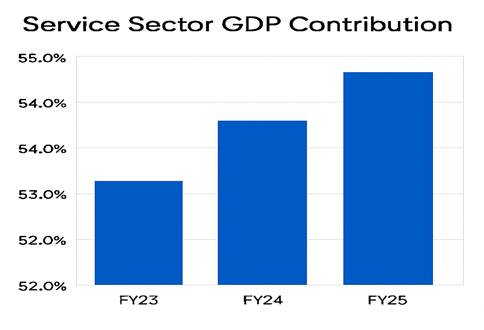
The services sector is the largest contributor to India’s GDP, accounting for 53.2% of Gross Value Added (GVA) in FY25 (Economic Survey 2025–26). It encompasses IT-BPM, financial services, logistics, trade, transport, tourism, healthcare, and education. Services exports reached USD 345 billion in FY25, surpassing merchandise exports growth, driven by IT services, consulting, and logistics.
Market Size and Growth Metrics
- Contribution to GDP (FY25): 53.2% (Economic Survey 2025–26).
- Services Exports (FY25): USD 345 billion (RBI/PIB).
- Employment Share: ~30% of workforce engaged in services (NITI Aayog).
- Logistics Market Size (FY25): ~USD 250 billion, projected to grow at 8–10% CAGR.
- Forecast: Services sector expected to grow at 7.5–8% annually until 2030.
Market Dynamics and Drivers
- Growth Drivers: IT-BPM exports, financial services, logistics expansion, tourism, healthcare, education.
- Supply Chain: Strong IT infrastructure, expanding logistics corridors, skilled workforce.
- Technological Trends: AI, cloud computing, fintech, e-commerce, digital health, logistics automation.
- Consumer Trends: Rising demand for digital services, online education, telemedicine, and e-commerce logistics.
Competitive Landscape
- Major Players
(IT & BPM): Infosys, TCS, Wipro.
(Logistics): CONCOR, Gati, Blue Dart, Delhivery.
(Financial Services): HDFC Bank, ICICI Bank, SBI.
(Healthcare & Education): Apollo Hospitals, Byju’s, NIIT.
- Supplier Power: Moderate; India’s skilled workforce is a key advantage.
- Buyer Power: High, with global clients demanding cost efficiency and quality.
- Threat of Substitutes: Growing due to automation, AI-driven platforms, and global competition.
Regulatory Measures
- Economic Survey 2025–26: Emphasis on boosting services exports and logistics efficiency.
- National Logistics Policy (2025): Target to reduce logistics cost to 8% of GDP.
- Digital India & Startup India Programs: Support for IT, fintech, and digital platforms.
- Tourism Policy (2025): Incentives for medical and cultural tourism.
- Education & Healthcare Reforms: Expansion of digital learning and telemedicine.
Macro Environmental Analysis
- Services exports resilient despite global slowdown.
- Logistics sector is expanding with multimodal transport corridors.
- Tourism is recovering post-pandemic, supported by government incentives.
- Financial services expand with fintech adoption and digital payments.
- Healthcare and education services are growing rapidly with digital integration.
SWOT Analysis
Strengths
- Largest contributor to GDP.
- Strong IT-BPM and financial services base.
- Expanding logistics and transport infrastructure.
- Skilled workforce and cost competitiveness.
Weaknesses
- Uneven growth across states.
- Dependence on global demand for IT services.
- Infrastructure gaps in logistics and tourism.
Opportunities
- Expansion of fintech, edtech, health-tech, and logistics automation.
- Rising demand for medical tourism.
- Growth in consulting and professional services.
- Digital economy integration with AI and cloud.
Threats
- Global recession risks impacting exports.
- Competition from other emerging economies.
- Regulatory challenges in data protection and logistics reforms.
- AI-driven automation risks displacing millions of mid-level IT and BPO jobs.
Future Outlook
- Services sector projected to contribute more than 55% of GDP by 2030.
- Exports expected to cross USD 500 billion by 2030.
- Logistics sector to play a critical role in reducing costs and improving competitiveness.
- Fintech, healthcare, education, and tourism will be key growth drivers.
- India’s services sector will remain the backbone of its economic growth under Viksit Bharat 2047.
Conclusion
India’s services sector is the engine of growth, contributing over half of GDP and driving exports through IT-BPM, finance, logistics, and digital platforms. Yet, global demand shifts, infrastructure gaps, and AI-driven automation threatening jobs and cost advantage highlight the need for reskilling and policy support to sustain resilience and competitiveness.
Sources
- Economic Survey 2025–26 (Ministry of Finance, Government of India)
- Press Information Bureau (PIB) Releases, 2025–26
- Open Government Data (OGD) Platform India
- NITI Aayog – Sectoral Reports (2025)
- National Logistics Policy (2025)
- Digital India & Startup India Programs (Ministry of Electronics & IT)
- Tourism Policy (2025, Ministry of Tourism)
- Education & Healthcare Reforms (MoE & MoHFW).
What is xCalData?
xCalData is a Made in India AI powered investment research platform called RHOMB.
Using multilayered neural network, RHOMB analyses over 150+ technical ratios, 150+ candlestick chart patterns and over 40 fundamental ratios of each stock.
RHOMB forecasts the stock price movement for the next few days and determines buy, sell, hold or wait.
How accurate is xCalData?
xCalData publishes the accuracy of the past trades for each stock to enable an informed decision.
Is xCaldata an Algo trading platform?
No, xCalData is not an algotrading platform. User decides when to buy or sell including, we only provide inputs for the decision.
Download the app for further stock level insights: https://open.xcaldata.com/apps/
Checkout the trades and detailed insights in the app

Popular Posts
-
Stock of Interest . August 23, 2024
#HSCL (NSE) Stock Report | 23 Aug 2024
-
Stock of Interest . August 23, 2024
Add Zerodha trading account to xCalData
-
Stock of Interest . August 23, 2024
What is xCalData , how to use it and how accurate is it?
-
Stock of Interest . August 23, 2024
Jurik Moving Average (JMA): A Profit Trading Insight