Sector Analysis
Posted On: February 27, 2026
Indian Telecommunication Sector Analysis | Feb 2026
Industry Overview
India’s telecom sector is the second-largest in the world by subscribers, with over 1.19 billion connections (Dec 2025, TRAI). The sector anchors India’s digital transformation, driven by rapid 5G rollout, rural connectivity expansion, and government-backed initiatives like BharatNet and Digital Bharat Nidhi. The Union Budget 2026–27 allocated ₹73,990 crore to telecom infrastructure, signaling strong policy continuity.
Market Size and Growth Metrics
- Subscribers (Dec 2025): 1.19 billion (wireless + wireline).
- Wireless Subscribers: ~1.16 billion.
- Internet Subscribers: ~900 million.
- Tele-density (Dec 2025): ~85%.
Telecom service revenue Growth
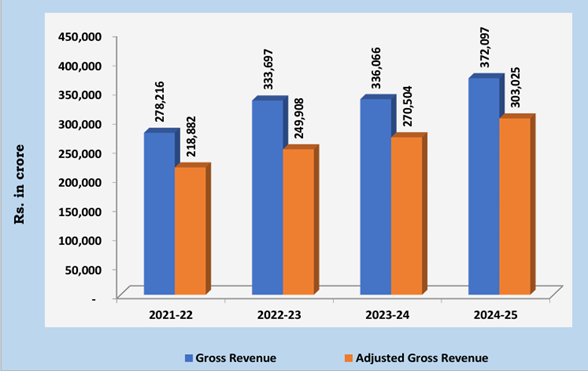
Source : TRAI
Market Dynamics and Drivers
- Growth Drivers: 5G deployment, BharatNet rural broadband, Digital Bharat Nidhi, rising data consumption.
- Supply Chain: Domestic manufacturing under PLI scheme, but challenges remain in component imports.
- Technological Trends: 5G labs, 6G research, AI-driven network optimization.
- Consumer Trends: Explosive mobile data usage, OTT services, digital payments.
Competitive Landscape
- Major Players: Reliance Jio, Bharti Airtel, Vodafone Idea, BSNL/MTNL.
- New Entrants: Satellite broadband providers (OneWeb, Starlink)
- Supplier Power: Moderate; dependence on imported telecom equipment persists.
- Buyer Power: High, with consumers demanding affordable data and quality service.
- Threat of Substitutes: Rising due to satellite internet, OTT communication apps.
Regulatory Measures
- DoT Initiatives (2025–26): BharatNet expansion, revival packages for BSNL/MTNL.
- TRAI Regulations: Spectrum pricing reforms, consumer protection guidelines.
- Union Budget 2026–27: ₹73,990 crore outlay for telecom, including USOF-backed rural connectivity.
- PLI Scheme: Incentives for domestic telecom equipment manufacturing.
Macro Environmental Analysis
- Telecom imports rose 21% in FY25, highlighting manufacturing challenges
- Only 766 active Wi-Fi hotspots out of 1 lakh installed under BharatNet (utilization gap).
- Government focus on inclusive digital ecosystem (Samaveshit, Viksit, Tvarit, Surakshit).
- Private investment in 5G and fiber networks accelerating urban and rural connectivity.
SWOT Analysis
Strengths
- World’s second-largest subscriber base.
- Rapid 5G rollout and strong private sector investment.
- Government-backed initiatives (BharatNet, Digital Bharat Nidhi).
Weaknesses
- Financial stress in legacy operators (Vodafone Idea, BSNL/MTNL).
- Low utilization of BharatNet infrastructure.
- Dependence on imported telecom equipment.
Opportunities
- 6G research and innovation.
- Satellite broadband expansion.
- Rising demand for digital services and OTT platforms.
- Domestic manufacturing under PLI scheme.
Threats
- Global supply chain disruptions.
- Cybersecurity risks in 5G networks.
- Intense price competition reducing margins.
- Regulatory challenges in spectrum pricing.
Future Outlook
· Subscriber base expected to cross 1.25 billion by FY27.
· India aims to achieve universal broadband coverage by 2030 under BharatNet.
· 6G research and satellite broadband will shape the next decade.
Conclusion
India’s telecom sector is a key enabler of digital transformation, supported by strong government investment, rapid 5G rollout, and expanding rural connectivity. While challenges such as financial stress in PSUs, low BharatNet utilization, and import dependence remain, the sector’s future is promising with 6G research, satellite broadband, and digital ecosystem expansion driving growth.
Sources
- Department of Telecommunications (DoT, Ministry of Communications) – Annual Report 2024–25
- Telecom Regulatory Authority of India (TRAI) – Subscription Data, December 2025
- Union Budget 2026–27 (Ministry of Finance, Government of India)
- PRS Legislative Research – Demand for Grants 2026–27 (Telecom Sector)
- Production Linked Incentive (PLI) Scheme for Telecom & Networking Products (DoT)
- BharatNet Project (DoT)
- Digital Bharat Nidhi (DoT, 2025)
What is xCalData?
xCalData is a Made in India AI powered investment research platform called RHOMB.
Using multilayered neural network, RHOMB analyses over 150+ technical ratios, 150+ candlestick chart patterns and over 40 fundamental ratios of each stock.
RHOMB forecasts the stock price movement for the next few days and determines buy, sell, hold or wait.
How accurate is xCalData?
xCalData publishes the accuracy of the past trades for each stock to enable an informed decision.
Is xCaldata an Algo trading platform?
No, xCalData is not an algotrading platform. User decides when to buy or sell including, we only provide inputs for the decision.
Download the app for further stock level insights: https://open.xcaldata.com/apps/
Checkout the trades and detailed insights in the app

Popular Posts
-
Stock of Interest . August 23, 2024
#HSCL (NSE) Stock Report | 23 Aug 2024
-
Stock of Interest . August 23, 2024
Add Zerodha trading account to xCalData
-
Stock of Interest . August 23, 2024
What is xCalData , how to use it and how accurate is it?
-
Stock of Interest . August 23, 2024
Jurik Moving Average (JMA): A Profit Trading Insight