

The Spinning Top candlestick formation is a single‑candle pattern that reflects hesitation in the market. Its defining feature is a small body with long upper and lower shadows, showing that prices moved significantly during the session but ultimately closed near the opening level.
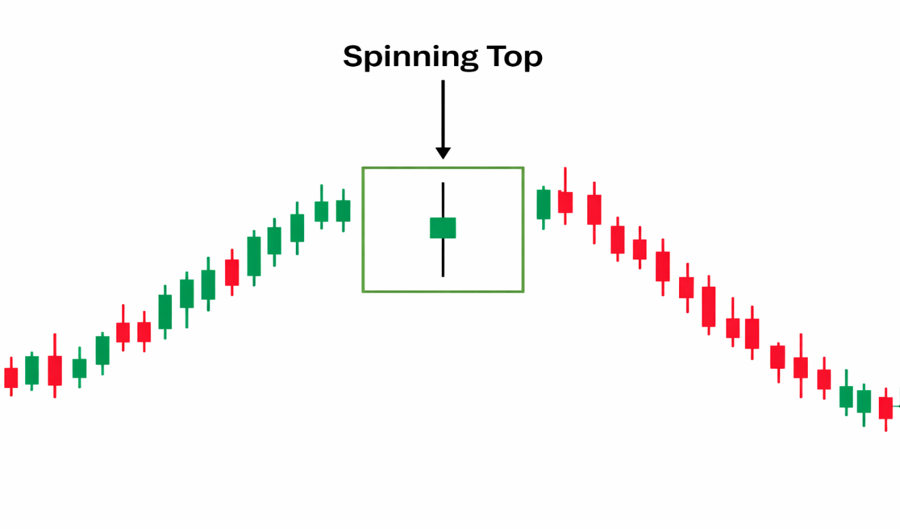
Candle Anatomy
- Body: Small, with little difference between open and close.
- Upper Shadow: Long, showing buyers pushed prices higher.
- Lower Shadow: Equally long, reflecting sellers drove prices lower before recovery.
- Color: Can be bullish (green/white) or bearish (red/black), but the small body is the key element.
Distinctive Attributes
- Appears in both uptrends and downtrends, making it versatile but context‑dependent.
- Represents indecision or balance, as neither buyers nor sellers dominate.
- Gains significance when it forms after prolonged moves, hinting at possible reversal or consolidation.
- Often considered a neutral signal unless confirmed by subsequent candles.
Sentiment Dynamics
- Buyer Push: Prices rise sharply as buyers attempt to extend control.
- Seller Response: Sellers counter aggressively, dragging prices lower.
- Final Outcome: The session ends near the open, reflecting hesitation and uncertainty.
This tug‑of‑war illustrates how the Spinning Top captures indecision, showing that both sides are active but neither secures dominance.
Analytical Considerations
- The Spinning Top is neutral on its own, offering no directional certainty.
- Without confirmation, it may represent only short‑term consolidation.
- Best interpreted when paired with momentum indicators (RSI, MACD), moving averages, or volume analysis to validate the breakout or reversal.
Contextual Importance
- At Market Tops or Bottoms: Can serve as a warning of potential turning points.
- During Strong Trends: May indicate a pause or exhaustion before continuation.
- Volume Confirmation: Higher trading activity in subsequent candles adds credibility to its interpretation.
Final Insight
The Spinning Top candlestick pattern is a versatile signal of indecision. Its distinctive structure — a small body with long shadows — reflects hesitation and balance between buyers and sellers. While not a strong standalone trigger, it becomes meaningful when placed in the context of trend direction and confirmed by subsequent price action. Recognizing it helps traders anticipate pauses, consolidations, or potential turning points, making it a useful tool in candlestick analysis.
