

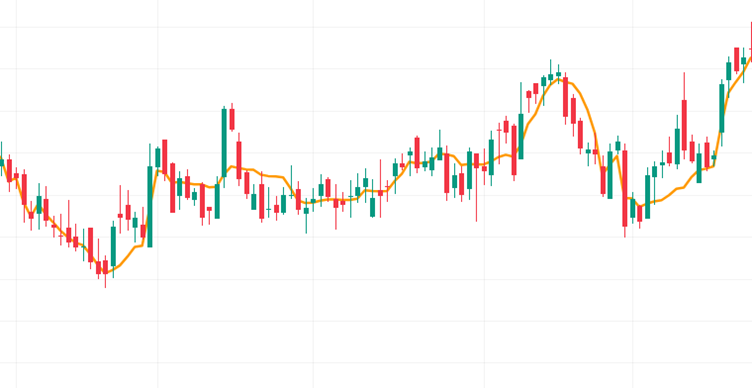
The Variable Index Dynamic Average (VIDYA), created by Tushar Chande, is a unique moving average that adjusts itself according to market volatility. Unlike traditional averages such as SMA or EMA, which rely on fixed smoothing periods, VIDYA modifies its sensitivity dynamically. This allows it to respond quickly during volatile phases while remaining steady in calmer markets, offering traders a flexible balance between responsiveness and stability.
Structural Components
VIDYA is constructed using three main elements:
- Base Average: Typically an exponential moving average (EMA) serves as the foundation.
- Volatility Index: Often derived from the Chande Momentum Oscillator (CMO) or similar measures.
- Dynamic Adjustment: The smoothing constant changes depending on volatility levels.
- High Volatility: VIDYA reacts faster, capturing sharp price movements.
- Low Volatility: VIDYA smooths out fluctuations, providing stability.
This adaptive design ensures VIDYA reflects real‑time market conditions rather than rigid averages.
Distinctive Attributes
- Adaptive Responsiveness: Adjusts automatically to volatility shifts.
- Noise Filtering: Reduces insignificant fluctuations during quiet markets.
- Trend Sensitivity: Captures momentum changes more effectively than fixed averages.
- Cross‑Market Utility: Works across equities, forex, commodities, and cryptocurrencies.
- Crossover Signals: Interactions with price or other averages generate actionable triggers.
Market Psychology Reflected
- Price Above VIDYA: Indicates bullish momentum, showing buyers are in control.
- Price Below VIDYA: Suggests bearish sentiment, reflecting seller dominance.
- Flattening VIDYA: Signals consolidation or weakening momentum.
- Divergence Between Price and VIDYA: Can highlight potential reversals or exhaustion.
This adaptability mirrors the ebb and flow of market sentiment, making VIDYA a valuable lens for interpreting crowd behavior.
Analytical Considerations
- VIDYA is highly effective in volatile markets, where traditional averages often lag.
- Traders frequently combine it with RSI, MACD, ATR, or Bollinger Bands to confirm signals.
- It is particularly useful for intraday and swing trading, where speed and accuracy are critical.
- In sideways conditions, VIDYA may generate false signals, requiring layered confirmation.
Contextual Importance
- Trend Confirmation: Sustained alignment of price with VIDYA validates bullish or bearish strength.
- Entry & Exit Guidance: Crossovers provide disciplined timing for trades.
- Risk Awareness: Helps avoid late entries by adjusting sensitivity to volatility.
- Reversal Alerts: Flattening or divergence often signals weakening momentum.
Final Insight
The VIDYA Indicator is a powerful adaptive moving average that balances responsiveness and stability by adjusting to market volatility. Its ability to filter noise during calm periods and react quickly during volatile swings makes it valuable for traders across all styles. While VIDYA should not be used in isolation, combining it with momentum or volume‑based indicators enhances accuracy and confidence. For traders seeking a disciplined, volatility‑aware approach to market analysis, VIDYA provides a reliable framework to navigate bullish and bearish markets effectively.
