

The Inverted Hammer candlestick formation is a single‑candle pattern that often appears at the end of a decline. Its unique structure resembles an upside‑down version of the classic Hammer, and it serves as a subtle indication that selling pressure may be weakening while buyers begin to test higher ground.
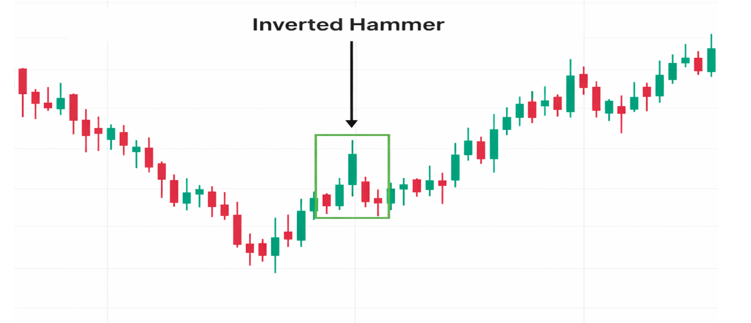
Candle Anatomy
- Body: Small, positioned near the bottom of the trading range, showing that the open and close are close together.
- Upper Shadow: Long, typically at least twice the size of the body, reflecting strong upward attempts by buyers.
- Lower Shadow: Very short or absent, emphasizing that sellers were unable to push prices much lower.
- Appearance: Resembles an inverted hammer, with the body at the base and the long upper wick acting as the handle.
Distinctive Attributes
- Commonly forms after a downtrend or extended selling pressure, making it a potential reversal marker.
- The long upper shadow highlights buyer attempts to regain control, even if the close remains near the open.
- Gains credibility when followed by a bullish candle in the next session or supported by strong trading volume.
Sentiment Dynamics
- Seller Control Early: Prices drop initially, reflecting bearish dominance.
- Buyer Pushback: Buyers step in, driving prices upward, but resistance prevents a strong close.
- Psychological Shift: Despite closing near the open, the long upper shadow signals emerging buying interest and hints at a possible reversal.
This sequence captures the transition from pessimism to hesitation, and finally to renewed bullish sentiment.
Analytical Considerations
- The Inverted Hammer is weaker than the standard Hammer, as buyers fail to secure a strong close.
- Without confirmation, it may represent only short‑term indecision rather than a true trend change.
- Best interpreted when paired with momentum indicators (RSI, MACD), moving averages, or volume analysis to validate the setup.
Contextual Importance
- At Market Bottoms: Acts as an early warning that selling pressure may be fading.
- During Extended Declines: Serves as a sign that buyers are beginning to resist further losses.
- Volume Confirmation: Heavy trading activity during the following bullish candle adds credibility to the reversal signal.
Final Insight
The Inverted Hammer candlestick pattern is best viewed as an early signal of potential bullish reversal. While not definitive on its own, it becomes powerful when confirmed by strong follow‑up buying or supportive technical indicators. For traders seeking early entry points, the Inverted Hammer offers valuable insight into shifting market dynamics, helping them anticipate opportunities before a full trend reversal unfolds.
