

September 2026 was one of the sharpest risk-off months of the year, driven by the US Federal Reserve’s first interest rate hike since July 2023 and a fresh escalation in the Strait of Hormuz crisis that pushed Brent crude above $100 a barrel at times during the month. Indian equities sold off, bond yields rose, the rupee weakened and notably gold fell rather than rallying as many investors had expected.

Fed Delivers First Rate Hike Since 2023
The FOMC (September 15–16) voted unanimously to raise the federal funds rate by 25 bps to 3.75%–4.00%, reversing the easing cycle. Chair Kevin Warsh cited core PCE inflation above 3% in every month of 2026 and Middle East tensions. The hike itself was widely expected, but the projections were hawkish: 16 of 18 policymakers see at least one more hike this year, and the median year-end rate is near 4.1%.
Oil Tops $100 on Hormuz Standoff
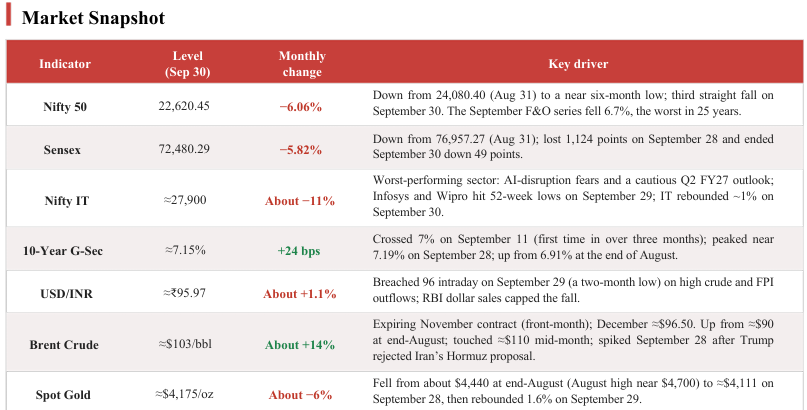
Brent futures closed August near $90, crossed $100 on September 9–10 and touched about $110 intraday in the second week of the month. Prices eased to the mid-$90s by September 21–22 before jumping on September 28, after President Trump rejected an Iranian proposal to reopen the Strait of Hormuz in exchange for sanctions relief. The expiring November contract briefly neared $108, while the more active December contract settled near $98. Prices then eased as Gulf crude exports hit a war-time high. On September 30 the expiring November contract traded near $103 and the more active December contract near $96.50; Brent was set for a monthly gain of about 14% on the front month basis (Reuters), its strongest since July. Roughly a fifth of global oil supply normally transits the Strait.
Indian Equities Near a Six-Month Low
The Nifty 50 closed at 22,620.45 on September 30, down 6.06% for the month (from 24,080.40) and near a six-month low, after a third straight session of losses. The Sensex fell 5.82% to 72,480.29. The September F&O series dropped 6.7%, its worst September series in 25 years and a all last seen in September 2001. On September 28 alone, the Sensex lost 1,124 points (1.52%) as oil spiked.
IT Bears the Brunt
The Nifty IT index fell about 11%, nearly double the decline in the broader market. Infosys, Wipro, KPIT Technologies and Tata Elxsi touched 52-week lows on September 29. Fears that AI will displace outsourcing revenue and a cautious outlook ahead of September-quarter (Q2 FY27) results weighed on the sector, although IT stocks bounced about 1% on September 30, led by TCS, Tech Mahindra and HCLTech,as hopes of another Fed hike eased. Domestic institutions bought about ₹52,600 crore of equities (provisional, September 1–25), which cushioned the broader fall.
Yields, Flows and the Rupee
Bond yields: The 10-year G-Secyield crossed 7% on September 11, touched about 7.19% on September 28 and eased to about 7.15% on September 30, up roughly 24 bps from 6.91% at the end ofAugust, on higher crude, a global bond sell-off and uncertainty over RBI liquidity.
FPI flows: FPIs were net sellers of about ₹17,100 crore in September (depositories data to September 25), after buying ₹20,200 crore in July and about ₹29,600 crore in August. Net outflows in 2026 are roughly ₹2.4 lakh crore, already above the ₹1.66 lakh crore sold in all of 2025.
Rupee: Breached 96 per dollar intraday on September 29, a two month low, but RBI dollar sales kept it just under that mark. It traded near ₹95.97 on September 30 (₹95.95 at the September 29 close), about 1.1% weaker for the month.
Market Outlook October 2026
Markets remainhighly sensitivetothe Fed’s ratepath (next FOMC decision on October 28), the Strait of Hormuz standoff and the RBI’s policy decision on October 7 (MPC meeting, October 5–7). All three are likely to keep volatility elevated in the near term.
Technical Level (Nifty 50)
Current zone Approximately 22,600 – 22,900
Resistance Key cap at 23,300–23,600.
Support Base at 22,000–22,300; a break below 22,000 would mark a fresh multi-month low
Our View and Analyst Take
We favour high-quality, domestically oriented businesses with pricing power and limited crude exposure, and we see the sell-off as a time to reassess position sizing rather than to make large directional bets. Stay selective within IT until earnings are clearer, keep some dry powder for volatility, and avoid over committing to either a hawkish-policy or a diplomatic breakthrough scenario. A Hormuz de-escalation would be the single biggest positive catalyst for Indian equities and the rupee.
Stay ahead. Subscribe for timely updates xcaldata


Disclaimer: Investments in the securities market are subject to market risks. Read all the related documents carefully before investing. Registration granted by SEBI and certification from NISM in no way guarantee performance of the intermediary or provide any assurance of returns to investors. This newsletter is for information and educational purposes only and does not constitute investment advice. Past performance should not be considered a guarantee of future returns.
