

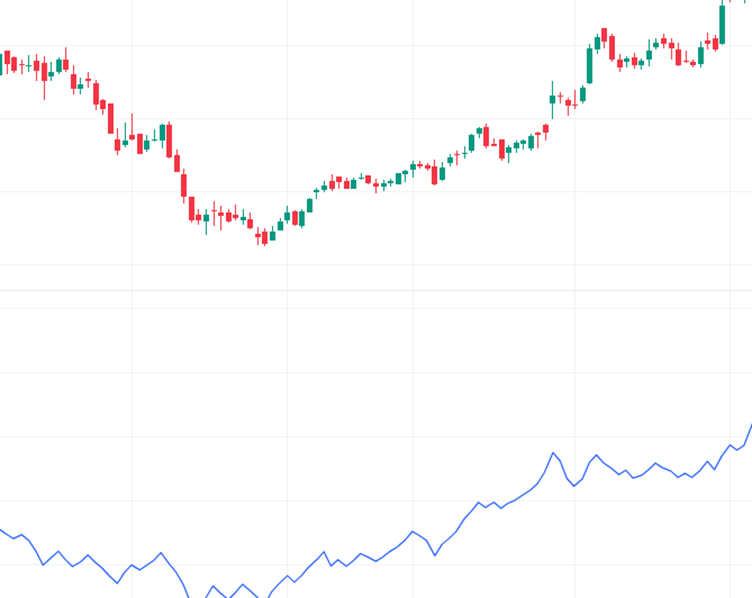
The On‑Balance Volume (OBV), introduced by Joseph Granville in 1963, is one of the earliest and most influential tools in technical analysis. It measures cumulative buying and selling pressure by adding volume on days when prices close higher and subtracting volume when prices close lower. The guiding principle is that volume often leads price—meaning significant changes in participation can foreshadow upcoming market moves.
Structural Components
The OBV calculation is straightforward:
- If Closing Price > Previous Close: OBV = Previous OBV + Current Volume
- If Closing Price < Previous Close: OBV = Previous OBV – Current Volume
- If Closing Price = Previous Close: OBV remains unchanged
This cumulative tally creates a running line plotted on charts, reflecting the flow of volume relative to price direction.
Distinctive Attributes
- Volume‑Driven Analysis: Focuses on participation rather than price alone.
- Trend Confirmation: Rising OBV supports bullish conviction; falling OBV signals bearish sentiment.
- Divergence Detection: When price moves one way but OBV moves the opposite, it often warns of reversals.
- Simplicity: Easy to calculate and interpret compared to more complex oscillators.
- Cross‑Market Utility: Works across equities, forex, commodities, and cryptocurrencies.
Market Psychology Reflected
- Rising OBV Line: Indicates accumulation, where buyers dominate.
- Declining OBV Line: Suggests distribution, with sellers in control.
- Flat OBV: Reflects indecision or balanced participation.
- Divergence Patterns: Reveal crowd hesitation when price continues upward but OBV fails to confirm strength.
This dynamic captures how traders interpret conviction behind moves, offering a structured view of sentiment transitions.
Analytical Considerations
- OBV is volume‑sensitive, making it effective for confirming breakouts and trend continuation.
- It is often paired with RSI, MACD, or moving averages for layered confirmation.
- Particularly useful for systematic models and discretionary traders, where volume confirmation reduces false signals.
- Customizable across different timeframes, from intraday to long‑term charts.
Contextual Importance
- Momentum Validation: Confirms whether price action is supported by strong participation.
- Reversal Alerts: Weak OBV during rising prices signals potential exhaustion.
- Noise Filtering: Provides smoother signals that reduce false entries.
- Decision Support: Enhances confidence by offering clearer visualization of market conviction.
Final Insight
The On‑Balance Volume (OBV) remains a cornerstone of volume‑based analysis. By tracking cumulative volume flow, it helps traders confirm trends, anticipate reversals, and refine decision‑making. Its simplicity and effectiveness make it a staple for both beginners and professionals. When combined with momentum or trend‑following indicators, OBV enhances accuracy and confidence, offering a disciplined framework to interpret bullish and bearish conditions across multiple financial markets.
