

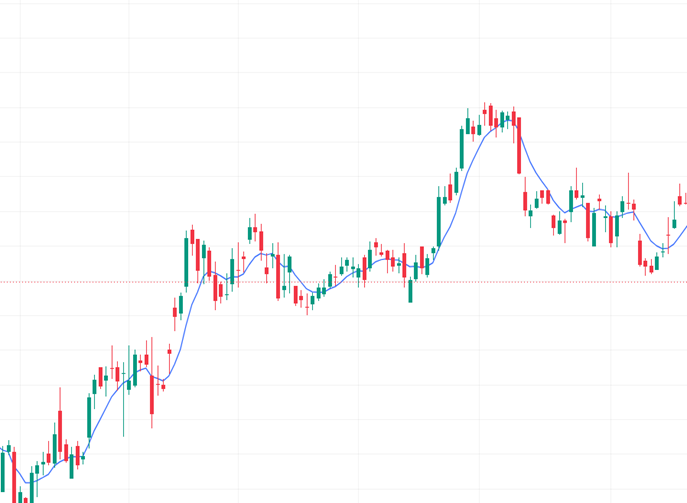
The Weighted Moving Average (WMA) is a refined version of the moving average family, designed to give greater emphasis to recent price data while still smoothing overall market movement. Unlike the Simple Moving Average (SMA), which treats all data points equally, WMA applies a declining weight to older values. This makes it more responsive to current market conditions, allowing traders to capture short‑term momentum without losing the benefit of trend filtering.
Structural Components
The WMA is calculated using the formula:
WMA=∑(Pricet×Weightt)∑Weights
- Price_t: Closing price at time t.
- Weight_t: Assigned weight, with the most recent data given the highest value.
- Normalization: Division by the sum of weights ensures accuracy.
For example, in a 5‑period WMA, the latest price is multiplied by 5, the previous by 4, and so on, before dividing by the total weight (15).
Distinctive Attributes
- Weighted Emphasis: Recent prices carry stronger influence, making WMA more sensitive to current momentum.
- Trend Responsiveness: Reacts faster than SMA but with less lag than EMA.
- Noise Filtering: Smooths price data while still highlighting meaningful shifts.
- Versatility: Applicable across multiple timeframes and asset classes.
- Crossover Utility: Interactions with price or other averages generate actionable signals.
Market Psychology Reflected
- Price Above WMA: Indicates bullish sentiment, showing buyers are in control.
- Price Below WMA: Suggests bearish momentum, reflecting seller dominance.
- Divergence: When price moves differently from WMA, it can highlight weakening momentum or potential reversals.
This responsiveness allows traders to interpret shifts in sentiment more quickly than with traditional averages.
Analytical Considerations
- WMA is highly effective in short‑ to medium‑term trading, where responsiveness is critical.
- Traders often combine it with RSI, MACD, Bollinger Bands, or volume analysis to confirm reliability.
- It is particularly useful for swing trading setups, where capturing momentum shifts early can improve timing.
Contextual Importance
- For Intraday Traders: Provides early signals for entries and exits.
- For Swing Traders: Helps confirm momentum shifts without excessive lag.
- In Volatile Markets: Offers faster reaction compared to SMA, but requires confirmation to avoid false triggers.
Final Insight
The Weighted Moving Average is a powerful enhancement of traditional moving averages. By emphasizing recent data, it equips traders with a more responsive view of price trends. Its ability to filter noise yet capture momentum makes it valuable across trading styles. While WMA should not be used in isolation, pairing it with momentum or volatility‑based indicators enhances accuracy and confidence. For traders seeking a disciplined, trend‑sensitive approach, WMA provides a reliable framework to navigate bullish and bearish markets effectively.
