

The Bullish Harami Cross is a nuanced candlestick formation that builds upon the traditional Bullish Harami pattern. Instead of a small bullish candle appearing within the body of a larger bearish candle, the second candle takes the form of a Doji — a session where the open and close prices are nearly identical. This unique structure introduces an element of indecision, signaling that the prior selling pressure may be losing strength and that a potential shift in sentiment could be underway.
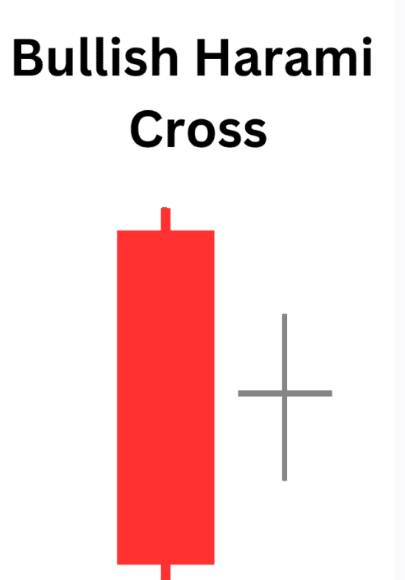
Candle Arrangement
- First Candle – Bearish Continuation: A long bearish candle extends the downtrend, reflecting strong selling momentum.
- Second Candle – Doji Pause: A Doji forms entirely within the body of the first candle, showing hesitation as neither buyers nor sellers establish clear dominance.
This containment, combined with the Doji’s neutrality, highlights a market that is pausing after sustained weakness.
Distinctive Attributes
- Most commonly appears after a prolonged decline, often near support levels.
- The Doji candle is the defining feature, representing indecision and loss of bearish conviction.
- The signal gains credibility when confirmed by subsequent bullish candles or increased trading volume.
- Its rarity makes it a noteworthy pattern when spotted in liquid markets.
Sentiment Dynamics
- Phase One – Seller Control: The first candle reflects strong bearish sentiment, with sellers driving prices lower.
- Phase Two – Market Hesitation: The Doji introduces uncertainty, as neither side gains control.
- Interpretation: Traders view this pause as a potential warning that bearish strength is fading. If buyers step in afterward, the pattern can mark the beginning of recovery.
In essence, the Bullish Harami Cross represents a market “stalling,” where selling pressure weakens and buyers prepare to re‑enter.
Analytical Considerations
- The Bullish Harami Cross is a subtle reversal signal, weaker than patterns like the Bullish Engulfing or Morning Star.
- It may sometimes indicate consolidation rather than a full reversal, especially in sideways markets.
- False signals are possible without confirmation, so traders often pair it with momentum indicators (RSI, MACD), moving averages, or volume analysis.
Contextual Importance
- Near Support Zones: The pattern is most effective when it appears close to established support levels, where selling pressure typically diminishes.
- Volume Confirmation: A spike in trading activity during or after the Doji strengthens the reliability of the signal.
- Follow‑Up Candles: Subsequent bullish sessions often validate the reversal, turning hesitation into upward momentum.
Final Insight
The Bullish Harami Cross is a subtle but powerful variation of the Harami family. While not the strongest reversal signal, its unique combination of a bearish candle followed by a Doji provides traders with an early indication that sentiment may be shifting. Recognizing this formation after a downtrend and confirming it with supporting indicators allows traders to anticipate recoveries and prepare for emerging opportunities.
Ultimately, the Bullish Harami Cross reminds us that even indecision can carry meaning. A single Doji, when placed within the body of a larger bearish candle, can serve as a quiet but important signal that the tide may be turning.
