

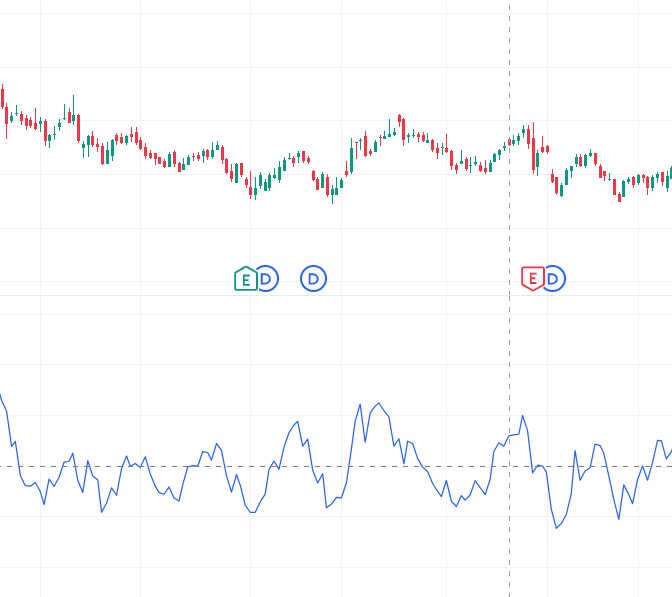
The Rate of Change (ROC) is a classic momentum oscillator that evaluates the percentage change in price between the current value and a past value over a chosen period. Unlike moving averages that emphasize direction, ROC highlights the velocity of price movement, making it a valuable tool for detecting acceleration, deceleration, and potential turning points in trends.
Interpolation enhancements further refine ROC readings by smoothing sharp fluctuations, improving readability, and reducing false signals caused by short‑term volatility.
Structural Components
The ROC formula is straightforward:
[ ROC = {Current Price – Previous Price}/{Previous Price} * 100
- Positive ROC Values: Indicate bullish momentum and rising price strength.
- Negative ROC Values: Suggest bearish momentum and selling pressure.
- Zero Line: Acts as a neutral threshold, with crossovers signaling shifts in momentum direction.
- Interpolation Layer: Smooths abrupt spikes, creating clearer visual interpretation.
Distinctive Attributes
- Momentum Quantification: Measures how quickly prices are changing relative to past values.
- Early Trend Recognition: Detects momentum shifts before price reversals become visible.
- Extreme Readings: Highlight exhaustion zones where reversals may occur.
- Divergence Detection: Identifies weakening trends when price and ROC move in opposite directions.
- Zero‑Line Crossovers: Provide simple bullish or bearish cues.
- Volatility Awareness: Highlights explosive acceleration phases in markets.
Market Psychology Reflected
- Strong Positive ROC: Suggests aggressive buying pressure and optimism among traders.
- Deep Negative ROC: Reflects strong selling conviction and bearish sentiment.
- Neutral Readings Near Zero: Indicate indecision or consolidation phases.
- Divergence Patterns: Reveal crowd hesitation when price continues in one direction but momentum fails to confirm.
This dynamic captures how traders perceive speed and conviction in market moves, offering insight into sentiment shifts.
Analytical Considerations
- ROC is momentum‑sensitive, making it effective for breakout validation and reversal anticipation.
- It is often paired with RSI, MACD, or moving averages to confirm signals.
- Particularly useful for short‑term traders who rely on speed analysis, as well as long‑term investors monitoring broader momentum cycles.
- Customizable look‑back periods allow adaptation to different assets and volatility conditions.
Contextual Importance
- Momentum Confirmation: Validates whether price action is supported by strong conviction.
- Breakout Strength: Rising ROC alongside price expansion confirms reliability of breakouts.
- Reversal Alerts: Detects weakening momentum before price shifts occur.
- Noise Filtering: Interpolation reduces false entries caused by random volatility spikes.
Final Insight
The Rate of Change (ROC) remains one of the most respected momentum indicators in technical analysis. By focusing on the speed of price movement, it helps traders detect acceleration, slowing momentum, and potential reversals with precision. Interpolation smoothing enhances clarity, reducing noise and improving confidence in decision‑making. For traders seeking to measure market velocity and anticipate shifts early, ROC provides a robust framework across equities, forex, commodities, and cryptocurrencies.
